
You and Your Past
The story I didn't know I was living

You and Your Past
The series is inspired by the teachings in Love, Service, Wisdom – The Ancient Inka Path to Inner Harmony by Jorge Luis Delgado, whose teaching has added new perspective to my understanding of forgiveness, self-love, and the stories we carry.
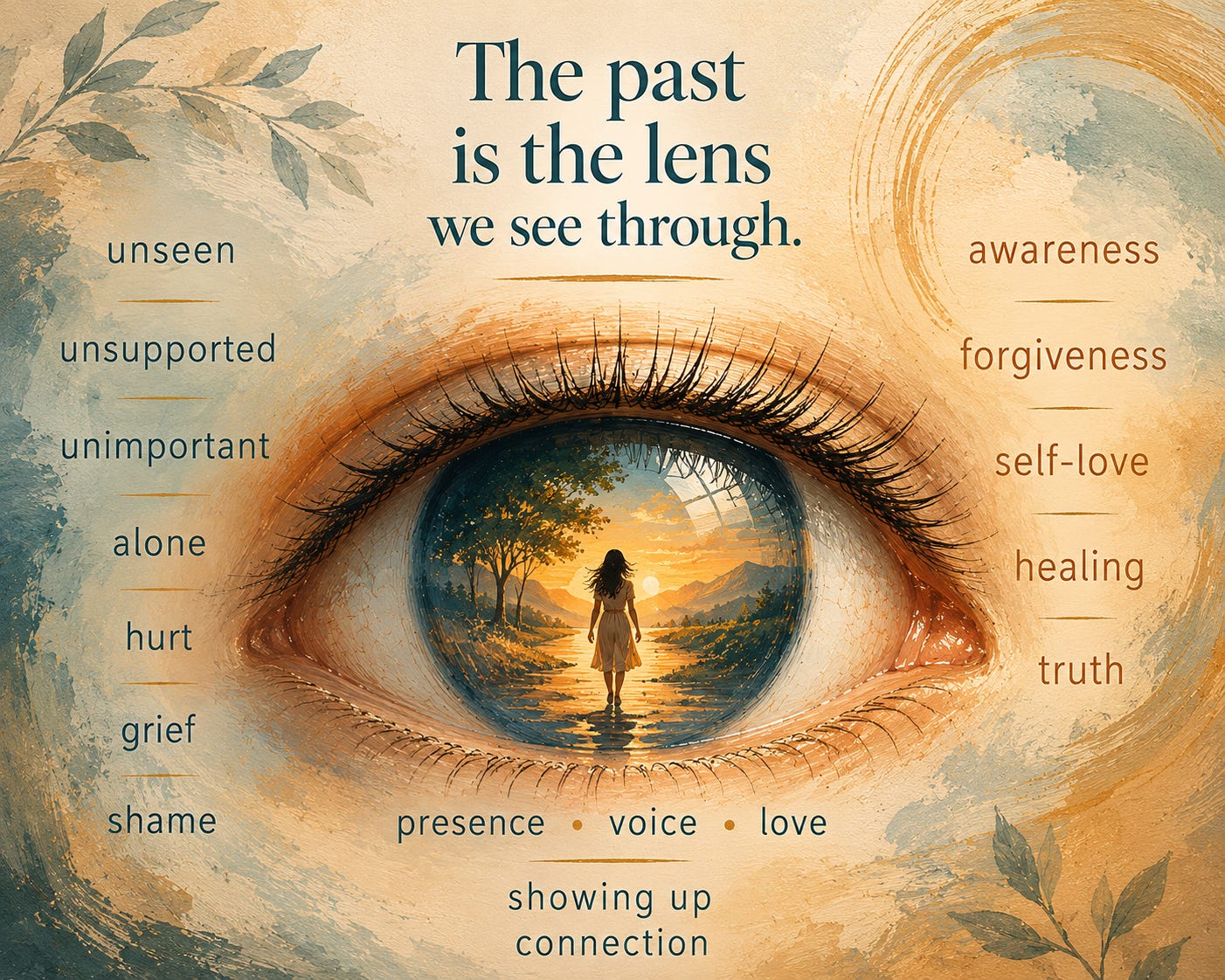
In the Aymara language (an indigenous language spoken in the Andes Mountains of Peru, Bolivia, and Chile), the word for “past” is also the word for “eye.”
This is translated to: We see through the past.
This translation stood out for me, because for most of my adult life, I thought I was seeing reality clearly, and I wasn’t.
I was definitely seeing life through the clouded lens of my past, and this affected how I showed up in every relationship and how I approached opportunities.
Growing up in the 1970s and 80s, I had very little emotional support. Like many children of Generation X, I was largely left to figure things out on my own.
At the time, I didn’t think much of it, this was simply how life was, but my operating system was integrating a new core story that would cloud my view of the world through for the next 35 years:
I don’t matter.
That story became much stronger when I was fifteen years old and my father left my mother, brother and I to live with a woman he was in love with.
No one sat my brother and me down to talk about it, explain what was happening, or ask, “How are you doing Tina?” In fact, it took us a while to even realize he had moved out.
And once that happened, during such a tender stage in life when I was transitioning from child to adult, I started feeling very alone and abandoned, which led to seeking attention in unsafe, unhealthy, and destructive ways.
No one helped me think about my future - what I wanted to do after high school and how to prepare for life, and no one ever checked in on me emotionally.
I was on my own. At least that’s how it felt to me.
The story of I don’t matter became more and more a core part of my operating system, and my foundation was cracked.
In the Andean tradition, there is a word called hucha. Hucha is often translated as heavy energy. It is the emotional weight we carry from painful experiences, unresolved hurts, grief, shame, resentment, regret, and the stories we form about ourselves during hurtful experiences.
Looking back, I can see that my I don’t matter story was carrying a tremendous amount of hucha. I was carrying the emotional weight of those experiences in my body and into my relationships, my decisions, and the way I saw myself.
The I don’t matter belief was such an ingrained part of my operating system, that it was just how I unconsciously showed up in the world. I didn’t even realize that I felt this way about myself until I was in my early fifties.
The belief was affecting how I felt and how I behaved:
I didn’t show up fully in important relationships because I genuinely believed my presence didn’t matter.
I didn’t always speak up because I believed my voice didn’t matter.
I often minimized my needs and put myself last because I believed they didn’t matter.
The Turning Point
This pattern became impossible to ignore when my father-in-law passed away.
My daughter and I had a special week-long mother-daughter trip abroad planned, and my husband was called to come to his father’s bedside in another state.
My husband assured me,“Go ahead, you two go on your trip, and I’ll go be with him.”
I easily accepted that permission, and I went on the trip.
They don’t really like me anyway. It doesn’t matter if I’m there or not.
While we were on our trip, he left his earthly body. My husband lost his father.
What I didn’t realize was that this situation had nothing to do with whether my in-laws liked me, the person who needed me was my husband. He needed his wife to give him emotional support. I mattered to him, and I couldn’t see that. I didn’t show up for him because I genuinely believed my presence didn’t matter.
It damaged our relationship for a while, and as painful as that was, I’m grateful it happened. It forced me to Expose The Roots of my I don’t matter story, recognize it for the lie that it was, and begin the work of forgiveness and healing.
You see, I was so used to people not showing up for me during hard times, I learned to be this way to myself and to others.
The I don’t matter story often showed up in my relationship with myself. I minimized or completely disregarded my needs, thoughts, and desires.
This was a huge reckoning for me. I experienced a lot of grief about all the ways I didn’t show up for people I loved, especially myself. By allowing that grief to flow, I moved it out of my body, and eventually, after months of grieving, I stopped living from that story.
Now I show up for myself and my close relationships in a much deeper way, and I seize opportunities with confidence.
Since then, I’ve observed that the narrative of I don’t matter is present for many women - many of my clients.
It may sound different for each woman. Maybe it’s one of these:
“My needs don’t matter.”
“My feelings don’t matter.”
“My voice doesn’t matter.”
“I don’t want to be a burden.”
That’s what makes our relationship with the past so powerful. Most of us aren’t just remembering the past. We’re living our lives through that lens.
We are seeing today’s relationships, opportunities, disappointments, and challenges through experiences that happened years or even decades ago.
And until we Expose The Roots of those lenses, we tend to mistake them for reality.
This is the first step in rewriting our stories: Awareness.
Today, I no longer believe that I don’t matter.
I know that my presence matters.
My voice matters.
My love matters.
My contribution matters.
Showing up matters.
And because I see myself differently, I experience life differently, and I have deeper relationships because I show up.
I’ve also learned to understand the gifts of my past, and like it states in Love, Service Wisdom, “When you bring harmony to your relationship with the past, you learn to see and appreciate the gifts of your experiences and share those gifts to lessen the suffering of others.”
One of the gifts I received was independence. I learned how to figure things out and how to adapt. I learned how to build a life from the ground up. I moved to New York City and built a career. Ten years later, I moved across the country to California. I navigated challenges that many people would have found overwhelming.
While I would never have chosen some of the experiences that shaped me, I am grateful for the strength and resilience that emerged because of them.
The transformation didn’t happen because I changed my past, it happened because I brought the hucha into the light, and I moved through my grief, I forgave myself and others, and I changed my story to “I matter.”
As a result, my close relationships have deepened, and I show up in the world with confidence and clarity.
In the Andean tradition, the goal isn’t to forget the past. The goal is to bring harmony to our relationship with it. When we do, the hucha begins to dissolve. We stop allowing old stories to define who we are, and we begin to recognize the wisdom hidden inside our experiences.
And perhaps most importantly, we become free to create a different future.
A reflection to ponder or write about this week:
What story about yourself was formed by your past?
How might that story still be influencing the way you see yourself today?
What strengths or gifts emerged from experiences you once viewed only as painful?
In the past Four weeks, we explored our relationship with the Mother, the Father, Family, and community
This exploration is part of the larger journey I guide with my co-facilitator, Jayne Jacova Feld of Jayne Says — through my offerings around self-love, acceptance, and speaking our truth, including The Art of Putting Yourself First, and the deeper work of voice, truth, and connection we explore in The Art of Standing in Your Truth.
This is the heart of what is addressed in all of Exposing The Roots’ offerings.
Together, we learn how to identify the stories we’ve inherited, question the beliefs we’ve carried, and create new stories to live that are rooted in self-love, truth, and self-acceptance.
Next week, we’ll explore our relationship with the future.
Until then, notice the lens through which you’re looking at your life.
You may discover that what you’ve been seeing as reality is actually a story waiting to be rewritten.